You're Running Your Business Audit Backwards
Most audits start with finance. Then HR. Then compliance. And by the time you've spent three weeks reviewing internal reports and chasing down paperwork, the actual problems "the ones costing you clients and revenue are still sitting there untouched."
This is not an execution gap. It is a sequencing error.
After working with more than 100 companies across healthcare, professional services, logistics, and manufacturing etc., the pattern is consistent: organizations prioritize what is easiest to measure, not what actually drives outcomes.Finance has spreadsheets. HR has checklists. Compliance has auditors. So those rooms get crowded. Meanwhile, The client experience often has none of the above. .
That's the problem. Here's the fix.
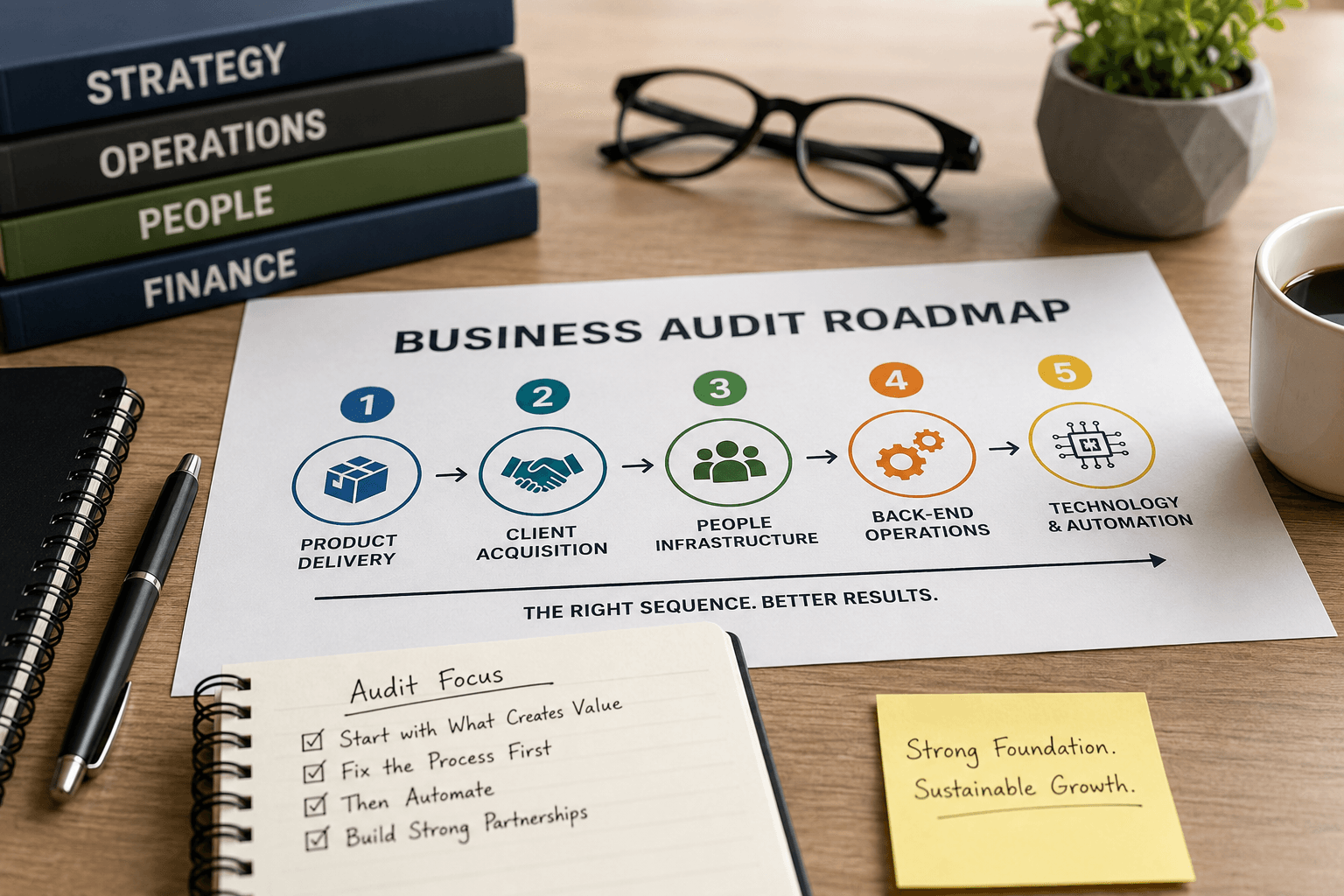
Start With Your Product or Service That's Where Value Is Delivered
Before reviewing a single internal report, examine how your business actually delivers its core product or service.
Not how it is presented in a proposal. Not how it is positioned in a sales deck. How it is executed today, the delivery mechanism itself. Is it documented? Can someone new to your team follow it and produce a consistent result? Does it reflect how your clients work with you today, or is it built around how they worked with you five years ago?
In many organizations, delivery has quietly drifted. Sales evolves. Markets shift. Client expectations change. But the underlying service model remains anchored in outdated assumptions.
The business continues to operate until the signals become unavoidable: increased rework, inconsistent outcomes, margin compression, and client attrition.
If the delivery engine is unclear, everything downstream becomes reactive.
Get this right first. Everything else depends on it.
Client Acquisition: The Whole Chain, Not Just the Numbers
Client Acquisition Is an Integrated System
Once delivery is understood, move upstream to how clients enter your business.
Client acquisition is not a function, it is a system. It includes positioning, messaging, sales execution, and onboarding.
Start with your market message. Is it current? Does it reflect what you do best today? Does it align with the problems your clients are actively trying to solve?
Outdated positioning does more than underperform; it disqualifies you before the conversation begins.
Then evaluate your sales process. Is it structured and repeatable, or dependent on individual style? Are your teams equipped with relevant case studies, clear value articulation, and defined objection handling or...... are they improvising?
And then, critically, onboarding.
The moment a client says yes is when trust is at its peak. What follows either reinforces that decision or begins to erode it. Yet in many organizations, onboarding is treated as a handoff rather than a strategic phase of the client experience.
That is a missed opportunity and often the beginning of avoidable friction.
Your People Are Part of the Product---
Most audits review HR. Very few evaluate talent as a direct driver of client outcomes.
Your people are not a support layer. They are the delivery mechanism. -This is where the invisible costs pile up, and where most audits go shallow.
Every strong performer who leaves takes client context, institutional knowledge, and often a few relationships with them. The real replacement cost: recruiting, ramp time, the quiet degradation in client experience during the transition almost never shows up cleanly on a balance sheet.
A meaningful audit asks:
- Are you attracting the level of talent your clients expect?
- Are new team members trained on how the business actually operates, not just how it is documented?
- Are you continuously developing the individuals who represent your brand in every interaction?
One Department of Labor audit, one misclassification dispute, one documentation gap; any of these can be extraordinarily expensive. Getting HR right isn't bureaucracy. It's protecting what you've built. But more than that, your people are the most direct channel between your brand promise and your client's experience. Treat them accordingly.
Now Look at the Back End
Finance. Billing cycles. Collection processes. Cash flow. KPIs. Compliance. These things matter ... but they sustain revenue. They don't generate it.
When I find cash flow problems, I trace them to their source before touching anything. Is it pricing? Billing structure? Contract terms? Collection culture? Each one has a different fix. Lumping them together and calling it a "cash flow problem" just delays the solution.
The same applies to compliance. Whether in healthcare, data security, or employment law, these are not periodic tasks. They are ongoing operational disciplines that enable the business to scale without unnecessary exposure. In any business with employees, staying current on employment law at the federal, state, and local level is an ongoing practice, not a once-a-year filing project. Understand why you're doing it not because an auditor is coming, but because you're building something that can grow without blowing up.
The back end matters. It simply should not be where you begin.
Fix the Process. Then Automate.
This is where many organizations create avoidable complexity.
They introduce software, implement workflow tools, or adopt AI before addressing the underlying process. The outcome is predictable: inefficiencies become standardized.
Technology is a multiplier.
If the process is sound, it creates speed, consistency, and scale. If the process is flawed, it amplifies confusion.
Before introducing automation:
- Clarify the process
- Eliminate redundancy
- Define ownership
- Align execution with reality
Then apply technology.
That is where meaningful leverage is created.
Your Partner Network Is an Asset. Treat It Like One.
Do Not Overlook Your Partner Ecosystem
One of the most underutilized assets in many businesses is the partner network.
In professional services and growth-stage companies, some of the highest-quality opportunities come through trusted referrals. These relationships are built over time and depend on clarity, consistency, and mutual value.
Audit this ecosystem deliberately.
- Do your partners understand your offering well enough to refer you accurately?
- Is your positioning easy to communicate?
- Are you investing in these relationships—and reciprocating where appropriate?
A strong partner network is not incidental. It is a strategic growth channel.
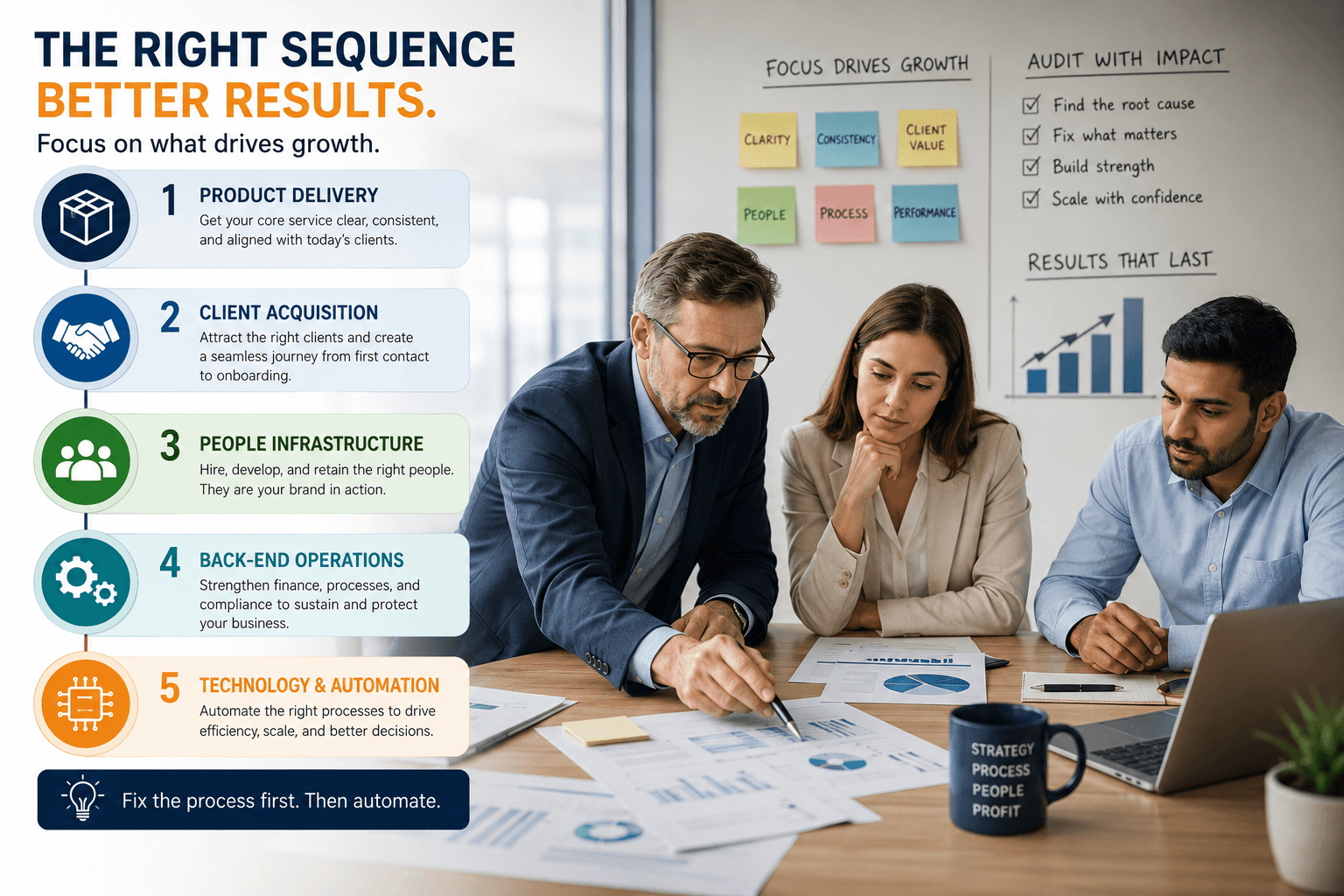
The Right Sequence Drives the Right Outcome
An effective audit follows a clear order:
- Product and service delivery.
- Client acquisition.
- People and execution infrastructure.
- Back-end operations.
- Technology and automation.
Most organizations reverse it.
They strengthen compliance while the client experience weakens. They organize internal systems while delivery becomes inconsistent. They invest in tools before addressing foundational gaps.
If the goal is meaningful improvement, the sequence must reflect how the business actually creates value.
Start with the client.
Start with delivery.
Start with the mechanisms that determine whether clients buy, stay, and refer.
The back end sustains the business.
The front end defines it.
---
Insights from Anwer Qureishi, Thought Leader & Entrepreneur
Anwer Qureishi is the Founder & CEO of ThinkQSI, a strategic advisory practice working with founders, operators, and growing businesses. He brings 30+ years of experience as an Advisor/Fractional CXO and has worked with 100+ companies across healthcare, professional services, logistics, and manufacturing.
If any of this matches what you're seeing in your own business, reach out.
Ready to accelerate growth? Schedule a Consultation