
Summer Is the Time to Pause, Assess, and Move First
Summer is a strategic pause: Why SMB Founder-Owner-Operator's should use this Moment to Assess, Realign, and Move First
Summer has arrived. The pace changes. Offices feel lighter. Clients travel. Teams cycle through vacations. The normal business rhythm softens for a few weeks.
Most founder-owners treat this as downtime, and they should take the vacation. Spend time with family. Step away from the daily noise.
Summer is one of the best times of the year to step back, evaluate the first half, and decide what needs to change before the fall rush and year-end pressure return. This isn't about working through vacation. It's about using the natural slowdown to think clearly, before September brings the speed back: customers re-engage, staff comes back, budgets tighten, and the calendar fills up fast. If you wait until then to diagnose what's off, you're already behind. The best time to look hard at your business is before urgency takes the decision out of your hands.
Your Business Has Already Told You What's Wrong
By summer, the business has told you a story. Your numbers are speaking. Your customers are speaking. Your team is speaking. Your stress level is speaking too. The question is whether you're listening.
Founder-owners usually feel what's off before a report ever shows it:
- Projects take too long to close out
- Decisions keep bouncing back to you
- Revenue looks fine, but profit is harder to explain than it should be
- The team is busy, but execution feels uneven
- Service is getting harder to deliver at the standard you built the business on
- New opportunities show up, but the company doesn't feel ready to absorb them
These aren't random irritations. They're signals, and signals deserve a real look.
Summer Gives You Something You Don't Usually Get: Space
For most of the year, you're operating under pressure from every direction sales, delivery, cash, people, customers, sometimes the board or the family. In that environment, strategic thinking is hard. You solve the problem in front of you because it's the loudest one.
Summer opens up a small window. The office slows down. The phones quiet a bit. Meetings get pushed. People are away. That space is worth using, because it gives you room to ask questions you normally don't have time for:
- What actually worked in the first half of the year?
- What did we keep tolerating that we shouldn't have?
- Where did we make money, and where were we just busy?
- Which customers are worth building the next chapter around?
- Which services or processes are creating friction we've stopped noticing?
- Where are we too dependent on one or two specific people?
- Where am I, as the founder, still the bottleneck?
- What has to get fixed before we push for more growth?
These aren't academic questions. They're operating questions, and the answers determine whether your second half is real progress or just a repeat of the first.
Being Busy Isn't the Same as Making Progress
From the outside, a lot of $20-50M companies look alive: meetings, quotes, deliveries, invoices, hiring, projects, the usual firefighting. But activity isn't progress.
A business can be busy and still be stuck. It can have real revenue and still leak margin. It can have healthy cash flow and still be fragile underneath. It can have good people and still run on unclear roles, broken handoffs, weak controls, and a founder who's still in the middle of everything.
Summer is the right time to pause, not because the business stops, but because the noise finally drops low enough for you to see the actual pattern underneath it.
Why an Operational Audit Matters Right Now
Most founder-owners don't need more motivational content. They need a clear, shared picture of how the business actually operates day to day.
That's what an operational audit gives you. At ThinkQSI, we look at the business from the inside out. How does work move from first contact to delivery and cash? Where do handoffs break? Where does rework keep happening? Where are people unclear on who owns what? Where do your systems fail to support the way you actually work? Where do decisions get delayed, or stay trapped on your desk? Where is real profit created, and where is value quietly leaking out through waste, rework, and delay?
This isn't about assigning blame. It's about visibility. You can't fix what you haven't mapped, you can't optimize what you don't understand, and you can't transform a company that's still running on assumptions. An operational audit gives you and your leadership team a common view of reality, and that alone changes the conversation.
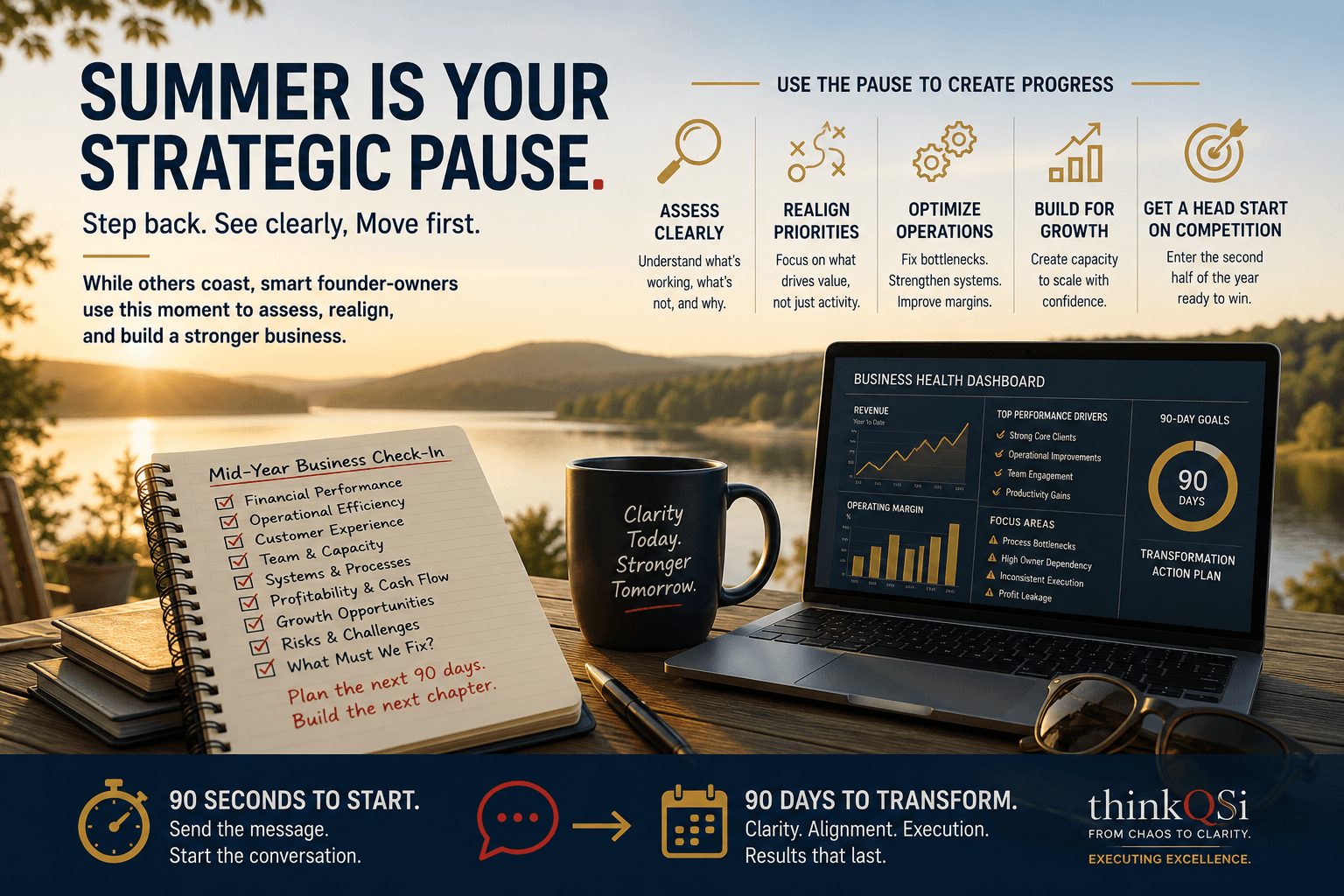
What to Fix First: The 90-Day Window
Once you can see the picture clearly, the next question is simple: what do you fix first? Not everything. The first 90 days should target the handful of changes that create the most practical impact.
In founder-led SMBs, that usually means:
- Clarifying workflows and handoffs
- Removing unnecessary steps and duplicate work
- Tightening operational controls and internal checks
- Improving reporting so problems surface earlier
- Defining decision rights so everything doesn't roll up to you
- Reducing founder bottlenecks in sales, delivery, and approvals
- Using automation only where it genuinely removes waste, not where it adds complexity
- Getting the leadership team aligned around a short list of priorities
The goal isn't disruption for its own sake. It's stabilizing the base, improving execution, and creating capacity for growth. A focused 90-day transformation won't turn your company into something unrecognizable, but it will change how it behaves day to day: less guessing, less friction, less firefighting, and a lot more clarity, control, and disciplined execution. That's where real momentum starts.
Why Summer Is the Right Time to Start
July and August run slower for most businesses outside of travel, tourism, and seasonal recreation. Staff rotate through vacations. Clients delay decisions. Leadership teams run offsites and planning sessions. That's exactly why this is the right window to start a 90-day transformation.
You can break the work into two or three phases and complete the first two by Labor Day. You'll head into fall with clearer processes, cleaner handoffs, and a better grip on what's actually driving profit, which frees you up to spend the rest of the year on growth and strategy instead of fighting the same fires again.
Small operational adjustments made now compound over time. Every peak season, every budget cycle, every hiring wave gets easier once the underlying system is stronger. Most companies wait until pain forces the issue: a margin squeeze, stalled growth, a key departure, customer complaints, or tighter cash. By then, the work is defensive. Summer gives you the chance to move before pressure makes the decision for you.
What You Should Be Asking Right Now
Sit down with your leadership team, your advisors, or an outside partner, and ask the questions you usually don't have time for:
- Are we operating the way we need to for the next stage of growth?
- Are our processes clear enough to actually scale?
- Do we know where profit is created and where it's getting lost?
- Am I, as the founder, still too dependent on myself?
- Are we using our people well, or just keeping them busy?
- Are our systems helping us, or creating more work?
- Are we prepared for growth, acquisition, transition, or succession?
- What has to get fixed in the next 90 days?
- What decisions are we still avoiding?
None of this requires panic. It requires honesty, and that's the starting point.
Let's Have the Conversation
At ThinkQSI, we work with founder-led companies in the $20-50M range, and around that band, who are growing, stuck, preparing for a transition, or just trying to move from daily firefighting to disciplined execution.
We start with an assessment. We prioritize what actually matters. Then we help you build and run a 90-day action plan that connects operational improvement to your bigger strategy. It's practical work: what's broken or unclear, what do we fix first, what impact should it create, who owns it, and what's different at 30, 60, and 90 days.
You get clarity. Your leadership team gets structure. The business gets momentum.
If you're a founder-operator and any of this sounds familiar, use the summer pause for what it's good for. Take the trip. Be with your family. But before the fall rush hits, give your business the same attention you give your customers, your team, and your family.
Reach out and let's talk about what your next 90 days could look like.
---
Insights from Anwer Qureishi, Thought Leader & Entrepreneur
Anwer Qureishi is the Founder & CEO of ThinkQSI, a strategic advisory practice working with founders, operators, and growing businesses. He brings 30+ years of experience as an Advisor/Fractional CXO and has worked with 100+ companies across healthcare, professional services, logistics, and manufacturing.
Ready to accelerate growth? Schedule a Consultation
ThinkQSI - From Chaos to Clarity. From Vision to Victory.