
Scammers Run Systems, So Should You (SMB's Survival Guide)
Stop Feeding the Scammers: Phone, Text, Email Defense for SMBs
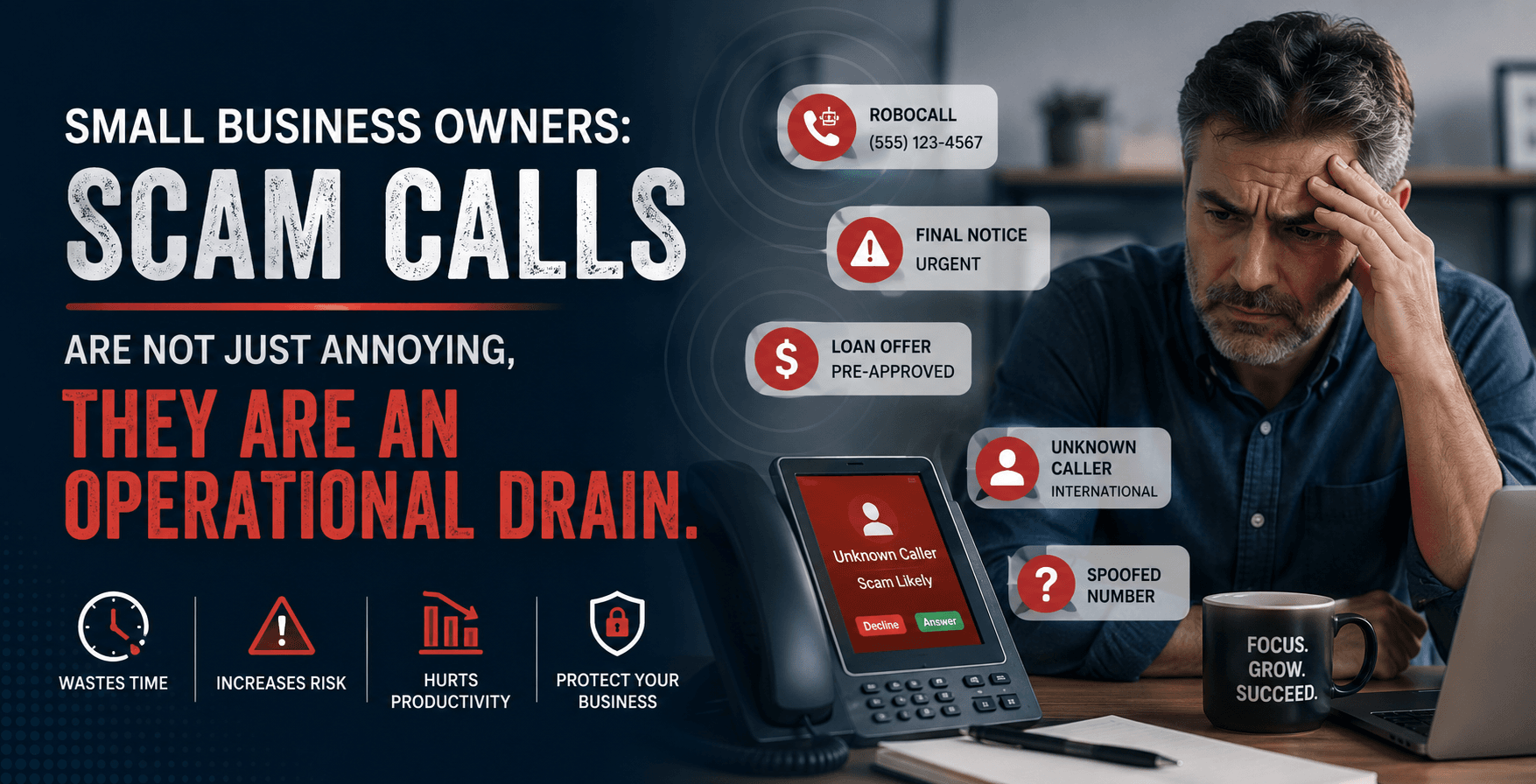
Small business owners: scam calls are not just annoying. They are an operational drain and a real security risk.
If you run an SMB, you are already dealing with robocalls, spoofed numbers, where callers pretend to be banks, government agencies, lenders, or even law offices. Several repeat the same message "applied loan", "request financing", "special one-time offer" etc. etc. It does not matter. The system keeps dialing.
These are not random events. They are organized, persistent systems designed to extract information and money.
Now translate that into business impact.
A receptionist answers.
An assistant engages.
A manager gets interrupted.
An owner stops mid-task to check voicemail.
Two minutes per call feels trivial. It is not.
10 calls per day × 2 minutes = 20 minutes
20 minutes × 5 days = 100 minutes per week
That is over 1.5 hours per week per person, lost to non-productive activity. Multiply that across a team, and you are now bleeding time, focus, and momentum.
But the bigger risk is not time. It is information leakage.
Modern scammers are trained. They follow scripts. Their goal is not to close in one call. Their goal is to extract one piece of data:
- Employee names or roles
- Owner availability
- Email formats
- Direct phone numbers
- Vendor relationships
- Banking or payment hints
- Software systems
- Physical location details
One small answer becomes the next step in a larger attack (phishing, impersonation, invoice fraud, or account takeover).
What to train your team to never do
- Do not confirm names, titles, or schedules.
- Do not verify ownership or decision-makers.
- Do not share emails or direct numbers.
- Do not confirm vendors, banks, or systems.
- Do not say “yes” to leading questions.
- Do not click links sent via text after a call.
- Do not call back unknown numbers from voicemail.
- Do not fill out forms on unknown “fraud recovery” websites.
If a caller is legitimate, they can identify themselves in writing through verifiable channels.
Simple phone handling script (use this in training)
“Please send your request in writing to our official business email. We do not verify or share information by phone.”
Repeat once if needed. Then disengage.
No escalation. No conversation.
Reporting and where to go (fact-checked)
Use only verified, government-backed channels:
- Federal Trade Commission (FTC)
- Federal Communications Commission (FCC) complaints
- National Do Not Call Registry (to reduce legitimate telemarketing)
- If SBA-related fraud is suspected: report via SBA Office of Inspector General (OIG)
Avoid “recovery services,” unsolicited legal outreach, or websites promising reimbursement. Many are secondary scams designed to collect your data.
Practical controls SMBs should implement immediately
- Call handling policy: define exactly how unknown calls are handled.
Verification policy: no information shared without written, verifiable identity. - Voicemail triage: batch review messages at set times instead of constant interruption.
- Contact hygiene: maintain a clean, centralized contact list.
- Use call filtering tools: enable carrier spam filters (AT&T ActiveArmor, Verizon Call Filter, T-Mobile Scam Shield) or VoIP screening tools.
- Separate personal and business numbers: never publish personal numbers.
- Use role-based emails (info@, billing@, support@) instead of individual exposure.
- Train staff quarterly: especially front desk, admin, and junior team members.
Emerging consideration: Identity Protection
Platforms like WhatsApp, Telegram have introduced username-based contact reduces unnecessary sharing of personal numbers. The broader principle is sound:
Limit how often your phone number is used as an identifier.
One example of how scams escalate
A caller asks: “Is John still handling vendor payments?”
An untrained employee replies: “No, that’s handled by Lisa now.”
That single answer enables a targeted phishing email to “Lisa” pretending to be a vendor, referencing real context. That is how invoice fraud starts.
Bottom line for SMB operators
Scammers operate like businesses: structured, persistent, and data-driven.
Small businesses need to respond the same way: with process, training, and discipline.
- If it is not verified, it is not trusted.
- If it is not documented, it is not shared.
- If it feels off, disengage.
Your time, your data, and your cash flow are all targets. Treat them accordingly.
Continued to Part 2:
LinkedIn Is Now a Hunting Ground. Don’t Make Your Business the Prey.
---
Insights from Anwer Qureishi, Thought Leader & Entrepreneur
Anwer Qureishi is the Founder & CEO of ThinkQSI, a strategic advisory practice working with founders, operators, and growing businesses. He brings 30+ years of experience as an Advisor/Fractional CXO and has worked with 100+ companies across healthcare, professional services, logistics, and manufacturing.
Ready to accelerate growth? Schedule a Consultation
ThinkQSI - From Chaos to Clarity. From Vision to Victory.