Optimization vs. Transformation: A Straight Talk for Founder-Led Businesses
If you run a $10-100M company, you don’t have time for buzzwords. You care about three things: keeping the lights on, paying your people, and building something bigger than where you started.
In that world, “optimization” and “transformation” get thrown around a lot. Most of the time, they’re used interchangeably. They’re not. Confusing them is one of the reasons good companies get stuck at the same revenue level for years.
At ThinkQSI, the work always starts with this simple distinction:
- Optimization is making today’s business run properly.
- Transformation is building the business you actually want to own in the future.
You need both but in the right order, and tied to a clear strategy.
What Optimization Really Means In Plain Language
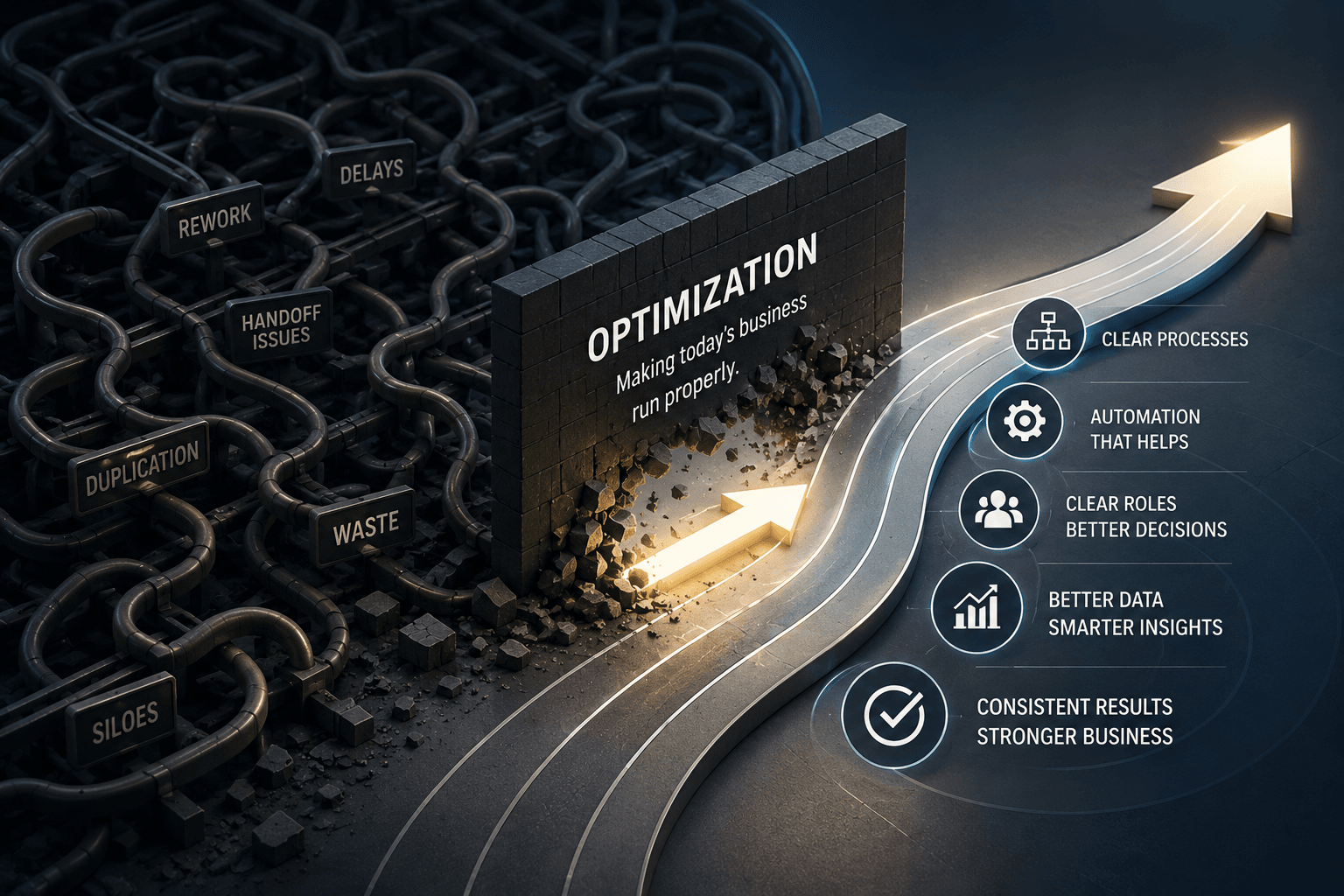
Optimization is about fixing how the business runs today. It’s not theory; it’s the stuff you feel every day as a founder:
- Things fall through the cracks.
- People are busy, but results are inconsistent.
- Customers get different answers depending on who they talk to.
- Cash comes in, but you don’t know exactly where the profit leaks out.
When ThinkQSI comes in, the first thing done is not a fancy slide deck. The first thing is an assessment of how work actually flows through your company:
- Walk the process from end to end (from first contact to cash and after-sales).
- Map where handoffs happen and where things get stuck.
- Identify breaks, rework, and any step that adds cost without adding value.
Then the optimization work begins:
- Clean up workflows so people know exactly what to do and when.
- Put in simple, practical systems and automation where they remove waste.
- Clarify roles so decisions don’t bounce around.
- Tighten up controls so you can trust your numbers.
The result:
- Fewer surprises.
- Less firefighting.
- More consistent delivery.
- Better use of the team you already have.
That’s optimization. It’s critical. But it won’t, by itself, change what your company is.
What Transformation Really Means (Beyond Just “Growing”)
Transformation is not “we grew 20% this year.” You can grow just by pushing harder and working longer—that’s not transformation; that’s exhaustion.
Transformation is when the business itself changes shape:
- You move into better markets or better customers.
- You offer higher-value products or services.
- You build a company that can run and grow without you being inside every decision.
This starts with a different conversation, one most founders skip because “we’re too busy”:
- Where are we really today? Not the story, the facts.
- Where do we want this company to be in 3–5 years?
- How big do we want it, and what kind of business do we want it to be?
- What needs to be true for customers, for money, for the team, for that to happen?
From there, ThinkQSI helps you build a simple but serious blueprint:
- Vision: What kind of business are you trying to build?
- Strategy: Which customers, markets, and offers are you going to focus on? What will you stop doing?
- Framework: What structure, processes, tools, and metrics will support that strategy?
- Team: Who needs to sit in which seats so this thing can actually run and grow?
Transformation is not a workshop. It’s the result of following that blueprint step by step until the company you run looks and behaves differently from the company you started with.
And here’s the key: you cannot transform without innovating - trying new things, building new offers, opening new doors. If growth and innovation are not on the table, you are not transforming; you’re just polishing.
How Optimization and Transformation Connect
Click link to read -> From a $25M firefighting operation to a Scalable, Strategy-driven Company (A Real-World Example)
Most founder-owners live in one of two traps:
They only optimize: always fixing, polishing, improving, but never changing direction.
Or they only chase “big ideas”: new products, new markets, new anything but the core business is chaotic, so nothing sticks.
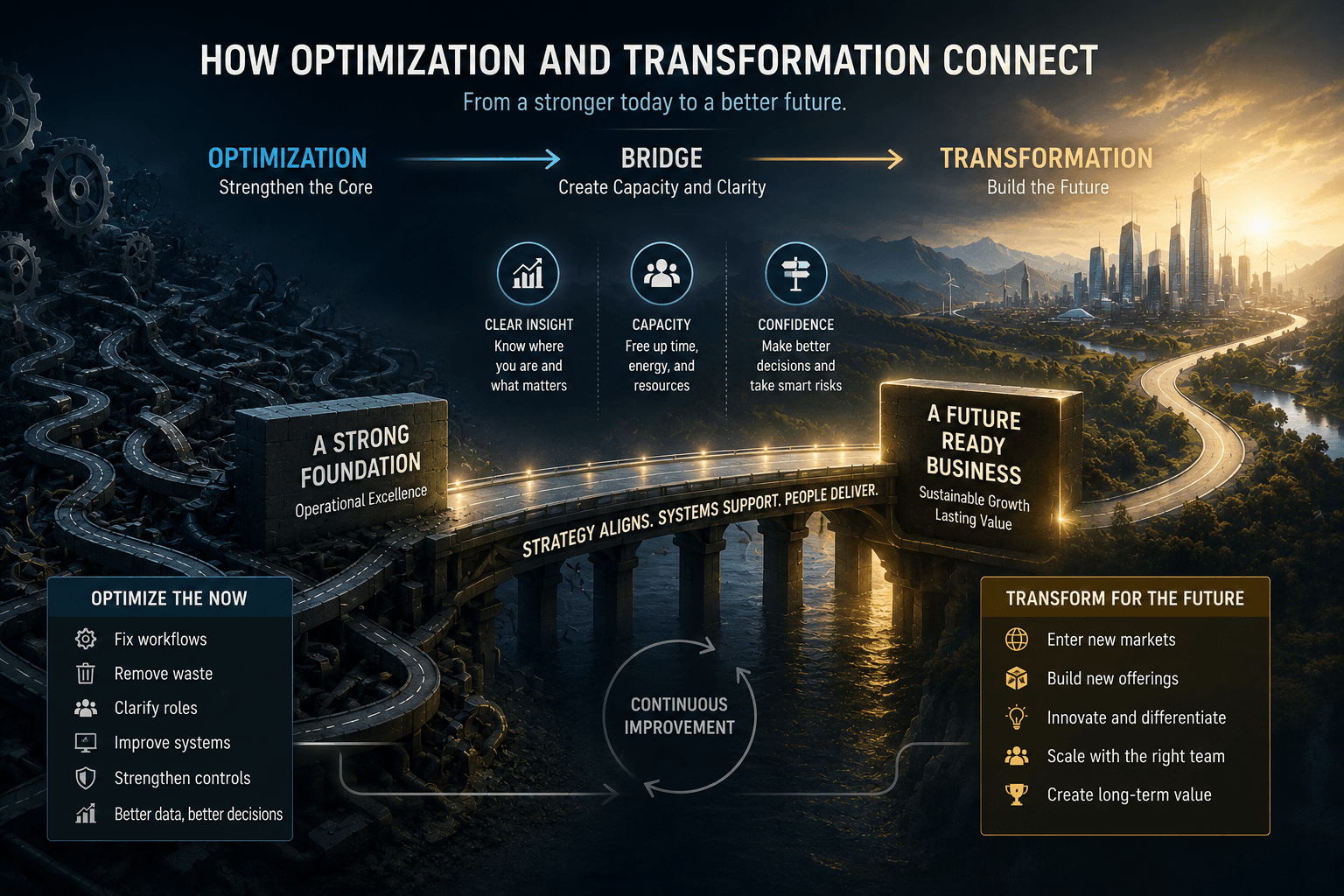
The right sequence looks like this:
1. Start with strategy
- Get clear on where you want to go and why.
- This stops you from “optimizing” things that don’t matter.
2. Optimize the current operation
- Fix the workflow.
- Fix the processes.
- Get the right tools in place.
- Stabilize cash, quality, and delivery.
3. Use that stronger base to drive transformation
- With less chaos, you and your leadership team have time and energy to innovate.
- You can take calculated risks because your core is under control.
- You can attract better talent and better customers because the business feels solid.
Optimization is the runway. Transformation is the flight. You cannot take off from a broken runway and you don’t build a runway just to sit on it.
Here’s a A Real-World Example: From Busy $25M Shop to Intentional Growth Company
Talking to the Founder and the Board at the Same Time
In many $40M+ companies, there’s a second audience in the room: a board of directors or a board of advisors.
- The founder wants to know: “What’s broken? What do we fix? What does it cost? What do I get?”
- The board wants to know: “Is there a strategy? Is this credible? What are the risks and returns?”
ThinkQSI’s approach is designed to satisfy both:
- For the founder: keep it practical, direct, and focused on action and results. No jargon, no fluff.
- For the board: show the assessment, the blueprint, the milestones, and the logic behind the recommendations.
The same framework works for both:
- Assessment →
- Strategy and vision →
- Blueprint and framework →
- Team and execution →
- Optimization feeding into transformation.
The founder feels understood and supported. The board sees structure, discipline, and a path they can back.
Why This Matters for You
If you are a founder-owner running a serious SMB, your dream and your reality sometimes pull in opposite directions. You know the business can be more, but the day-to-day keeps you stuck in the weeds.
The way out is not another tool, another hire, or another “growth hack.” It is:
- Get clear on the future you want to build.
- Build a framework and team around that future.
- Optimize the business you have.
- Use that stronger base to transform into the business you actually want.
That’s the work ThinkQSI does; side by side with you, not from a distance.
---
Insights from Anwer Qureishi, Thought Leader & Entrepreneur
Anwer Qureishi is the Founder & CEO of ThinkQSI, a strategic advisory practice working with founders, operators, and growing businesses. He brings 30+ years of experience as an Advisor/Fractional CXO and has worked with 100+ companies across healthcare, professional services, logistics, and manufacturing.
Ready to accelerate growth? Schedule a Consultation
ThinkQSI - From Chaos to Clarity. From Vision to Victory.